
A perfect book to start reading on International Women’s Day, during Women’s History Month, or anytime. Enjoy! 🙂
I bought this book because I love stories about outdoor journeys, especially if they are written by women. (Rough Magic by Lara Prior-Palmer and This Road I Ride by Juliana Buhring come to mind immediately). Windswept was doubly intriguing because it was part memoir and part women’s history. Abbs studied six “walking women” – women who walked for pleasure, and for whom walking was a part of their identity, even if they were mostly known for other things. As Abbs learned, she also walked, retracing their footsteps as best she could in landscapes that were often much changed.
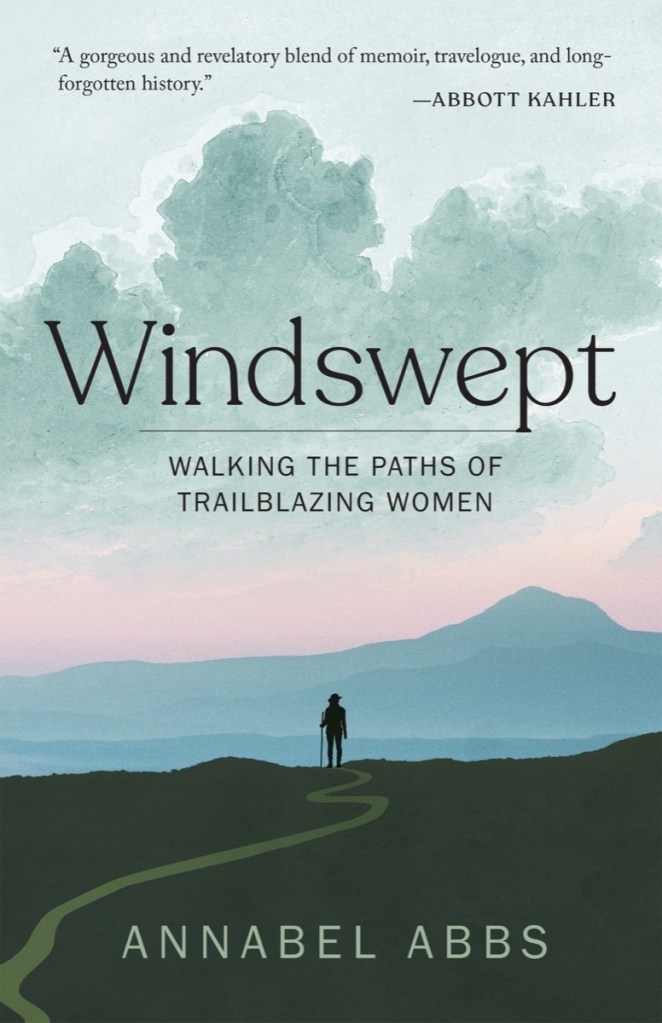
I started reading Windswept over the holidays in Evergreen, a mountain town on Colorado’s Front Range. When our flight back was cancelled (one of thousands cancelled due to weather and the pandemic), we decided to rent a car and drive the 1,700-mile return trip to Maryland. My kids were able to see the Great Plains and Kansas prairie and I was able to spend two car-bound days reading.
Maybe it was my enforced captivity that made the book so appealing. Abbs describes numerous hikes in faraway locales: Germany, Italy, France, Scotland, Texas, and New Mexico. Even if I don’t aspire to repeat Abbs’ (or Prior-Palmer’s or Buhring’s) exact adventures or routes, I find these stories incredibly inspiring.
Who would I recommend this book to?
Anyone who loves nature writing or outdoor adventure stories, with the caveat that these walks are on the milder rather than wilder side. There is no race. This is no woman-against-nature story.
Anyone who enjoys stories about understudied women. Many of the women Abbs studied are famous, but not as hikers or naturalists. But after Abbs’ presentation, maybe they should be.
Anyone who is interested in any of the women Abbs showcases: Frieda von Richthofen (D.H. Lawrence’s wife and muse), Gwen John (Welsh portrait artist), Clara Vyvyan (unfairly forgotten English writer and hiking partner of Daphne du Maurier), Nan Shepherd (Scottish nature writer), Simone de Beauvoir (French writer and feminist philosopher), and Georgia O’Keeffe (American abstract artist).
I’m torn about whether having prior knowledge of these women would make the book more enjoyable. Except for du Maurier and O’Keeffe, I hadn’t heard of any of them, so part of the appeal was Googling them and learning a bit more about them. But my lack of prior knowledge also meant it was difficult for me to keep track of their individual stories.
Things you might not like
Scrolling through Goodreads reviews, I saw that a few readers took issue with Abbs including so much of her own experiences in the book. Huh? That was the point. Without Abbs connecting the six walking women through her own story, Windswept would have been little more than a dry, academic textbook.
Abbs also seemed to spend an outsized amount of time, word count, and analysis discussing fear. Fear of heights, fear of men, fear of the woods…
I’m not saying these fears aren’t sometimes justified, just that it was the biggest part of the book I had trouble relating to. Sure, I’m afraid of things. And I also share Abbs’ fear of heights. Climbing walls and cliffsides make my legs feel like they’re made of jelly. Observation towers, cathedral cupulas, lighthouses – all have been known to cause panic in me. (Oddly, airplanes don’t. Fear is weird.)
But I don’t, as a rule, fear men or silent, dark forests. At times, I felt as if Abbs’ frequent reversion back to the theme of fear underscored it rather than vanquished it. Maybe it’s that when fear is such a significant part of any story, I prefer stories that end with an unquestionable, cathartic conquering of that fear.
But that’s no reason not to read the book. In fact, the opposite. Abbs’ treatment of fear is one of the most interesting parts of Windswept and maybe the one most worth discussing.
Final Thoughts
Abbs bookended her collection of stories with references to the fact that her three-year journey retracing these women’s hikes and learning about their lives was her way of dealing with an empty nest. Since my younger daughter is bound for college next year, it’s a motive I sympathize with.
The book ends on a comforting note. The last chapter is titled “Home” and includes some cute texts from Abbs’ kids. She reminds readers that, for most of history, women walked for mundane reasons, not because they were trying to escape trauma or transform themselves.
Windswept is an exploration of the interrelatedness of self, walkabouts, and home.
 Windtree Bee